NASA discovered and Interstella comet 3I/ATLAS
July
02
NASA discovered an interstellar comet, 3I/ATLAS, passing through our solar system in 2025.
Meaning & Importance:
This is an object from outside our solar system, offering a chance to study alien materials.
Helps scientists learn about what lies beyond our solar system and how our own system formed.
A real “visitor” from another star system — exciting and mysterious!
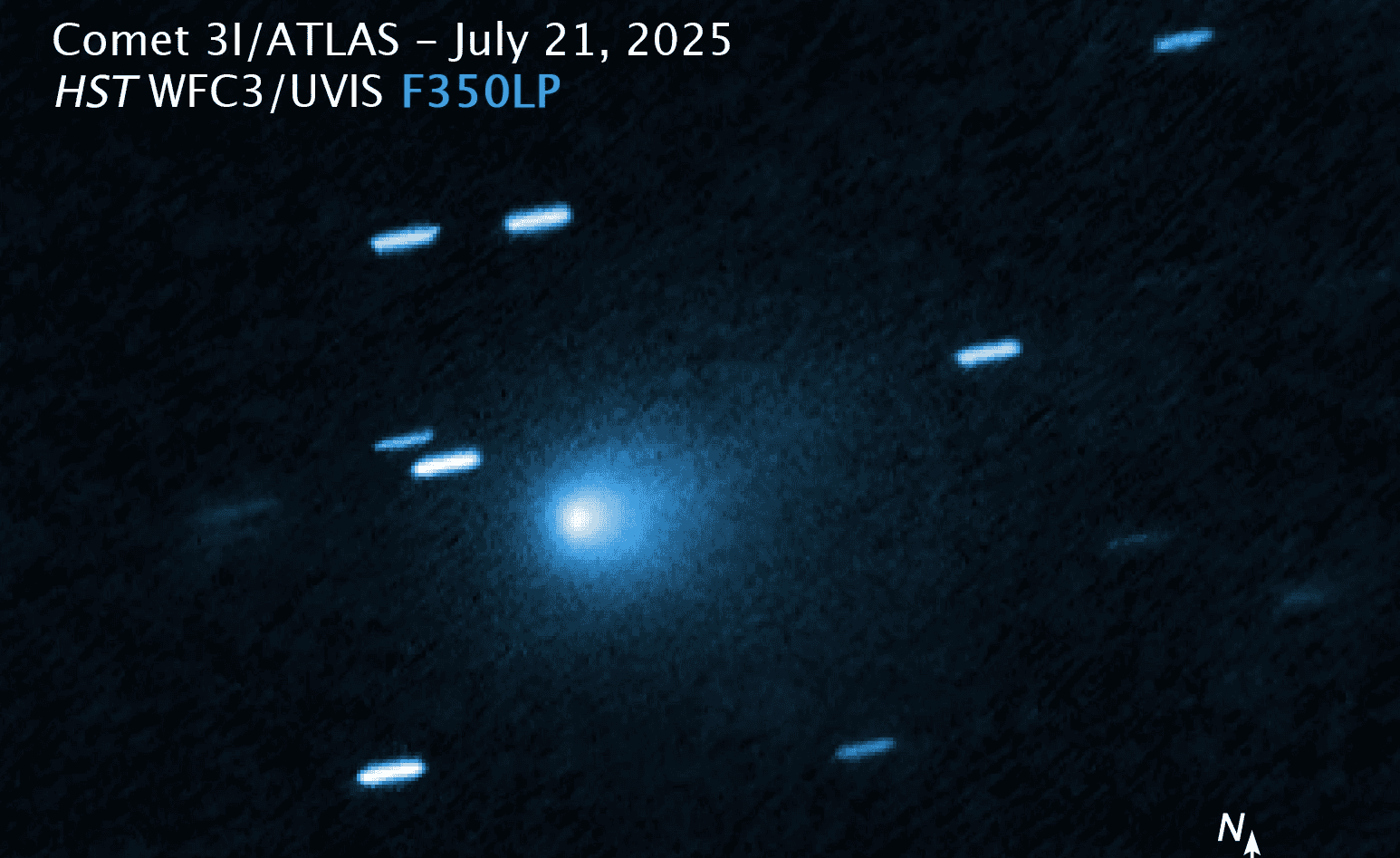
On July 1, the NASA-funded ATLAS (Asteroid Terrestrial-impact Last Alert System) survey telescope in Rio Hurtado, Chile, first reported observations of a comet that originated from interstellar space. Arriving from the direction of the constellation Sagittarius, the interstellar comet has been officially named 3I/ATLAS. It is currently located about 420 million miles (670 million kilometers) away.
Since that first report, observations from before the discovery have been gathered from the archives of three different ATLAS telescopes around the world and the Zwicky Transient Facility at the Palomar Observatory in San Diego County, California. These “pre-discovery” observations extend back to June 14. Numerous telescopes have reported additional observations since the object was first reported.
The comet poses no threat to Earth and will remain at a distance of at least 1.6 astronomical units (about 150 million miles or 240 million km). It is currently about 4.5 au (about 416 million miles or 670 million km) from the Sun. 3I/ATLAS will reach its closest approach to the Sun around Oct. 30, at a distance of 1.4 au (about 130 million miles or 210 million km) — just inside the orbit of Mars.
The interstellar comet’s size and physical properties are being investigated by astronomers around the world. 3I/ATLAS should remain visible to ground-based telescopes through September, after which it will pass too close to the Sun to observe. It is expected to reappear on the other side of the Sun by early December, allowing for renewed observations.