New Moon of Uranus
Aug
19
A previously unknown small moon orbiting Uranus was discovered using the James Webb Space Telescope
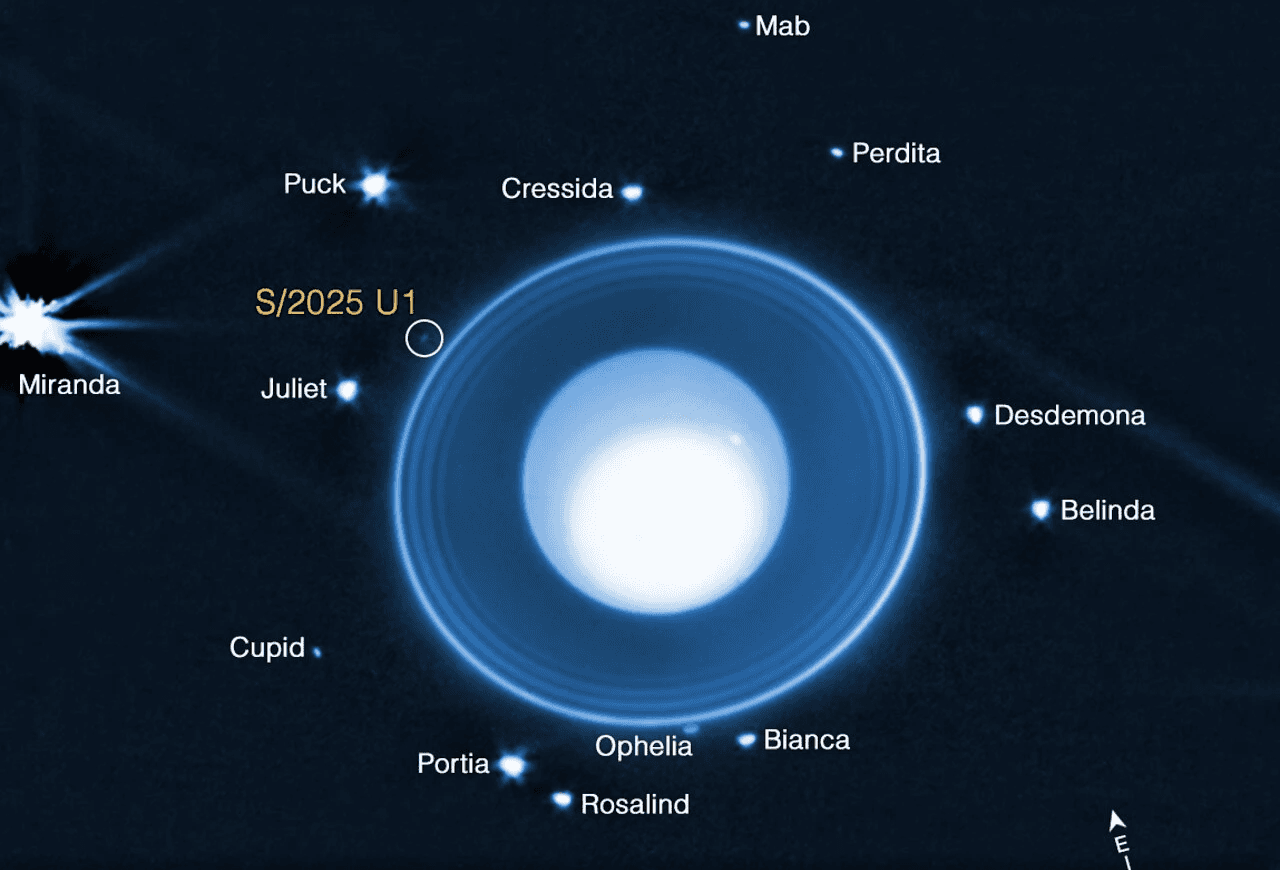
Scientists find tiny new moon around Uranus with the James Webb Space Telescope
Astronomers using NASA's James Webb Space Telescope have discovered a newfound moon orbiting icy Uranus, the seventh planet from the sun.
The moon, known as S/2025 U1, is just 6 miles (10 kilometers) or so in diameter, which made it invisible to NASA's Voyager 2 probe during its 1986 flyby of the planet, as well as rendering it undetectable by other telescopes. But then came the powerful James Webb Space Telescope (JWST).
A team led by scientists at the Southwest Research Institute (SwRI) in Colorado made 10 different 40-minute exposures of Uranus using JWST's Near-Infrared Camera (NIRCam) in order to find the small moon. Its discovery brings the total number of known Uranian moons to 29.
"No other planet has as many small inner moons as Uranus, and their complex inter-relationships with the rings hint at a chaotic history that blurs the boundary between a ring system and a system of moons," said Matthew Tiscareno of the SETI Institute in Mountain View, California, a member of the team behind this discovery, in a statement. "Moreover, the new moon is smaller and much fainter than the smallest of the previously known inner moons, making it likely that even more complexity remains to be discovered."
Uranus has 13 rings, which are divided into an inner system and a pair of outer rings. Unlike the ring systems of Jupiter and Saturn, Uranus' rings are made up of dark material and are more difficult to observe. The planet's 14 inner moons orbit among the faint inner rings, and some of these moons help hold some of the planet's rings in shape.