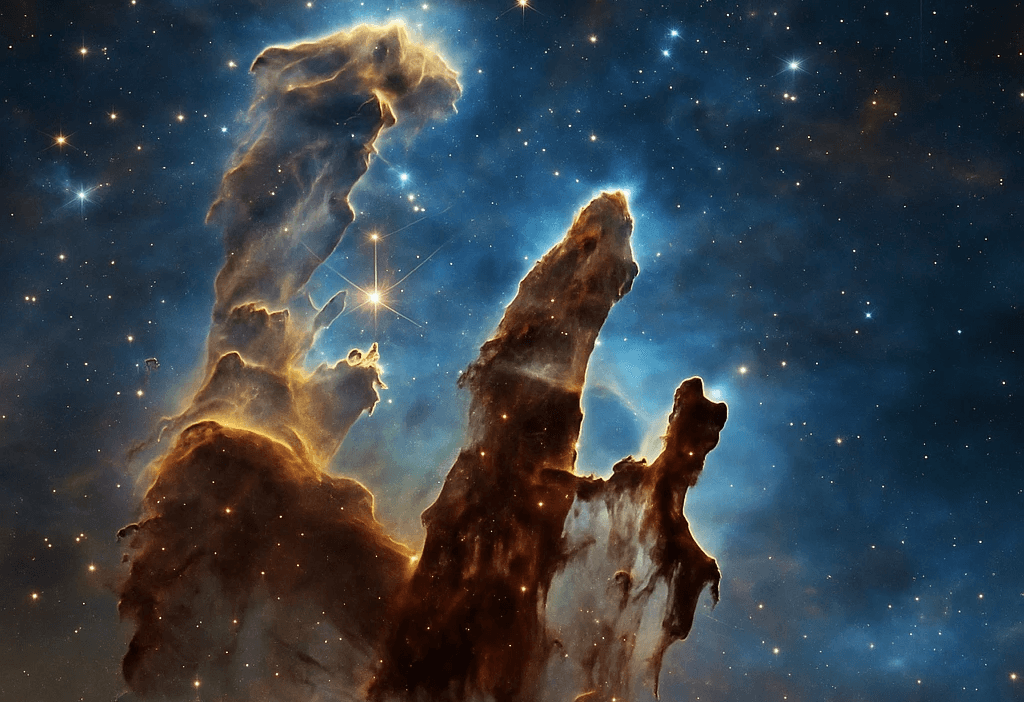
James Webb Space Telescope
The James Webb Space Telescope is the most powerful space observatory ever built, designed to explore the universe using advanced infrared technology to reveal distant galaxies and hidden cosmic structures.
It allows scientists to look deeper into space and further back in time than ever before, helping uncover the origins and evolution of the universe.
The James Webb Space Telescope was launched on December 25, 2021, from the Guiana Space Centre in Kourou, French Guiana.
It was then successfully positioned and deployed at the Sun–Earth L2 (Lagrange Point 2), about 1.5 million kilometers (930,000 miles) from Earth, arriving there on January 24, 2022, where it now operates in deep space.
1. Basic Introduction
The James Webb Space Telescope is the most powerful space telescope ever built, designed to explore the universe in unprecedented detail. It observes distant galaxies, stars, and planets using advanced infrared technology.
2. Scientific Focus
JWST is a next-generation space observatory that studies the formation of the first galaxies, the evolution of stars, and the atmospheres of exoplanets by detecting faint infrared light from the early universe.
3. Technical-Oriented Introduction
Launched by NASA, ESA, and CSA, the James Webb Space Telescope features a 6.5-meter gold-coated mirror and operates in deep space, allowing it to capture extremely detailed images beyond the reach of previous telescopes.
4. Educational Meaning
The James Webb Space Telescope is a giant eye in space that helps scientists look farther back in time than ever before, showing how stars and galaxies were formed billions of years ago.
5. Inspiration
The James Webb Space Telescope opens a new window to the cosmos, revealing hidden worlds and ancient light, and helping humanity better understand the origins of the universe.